

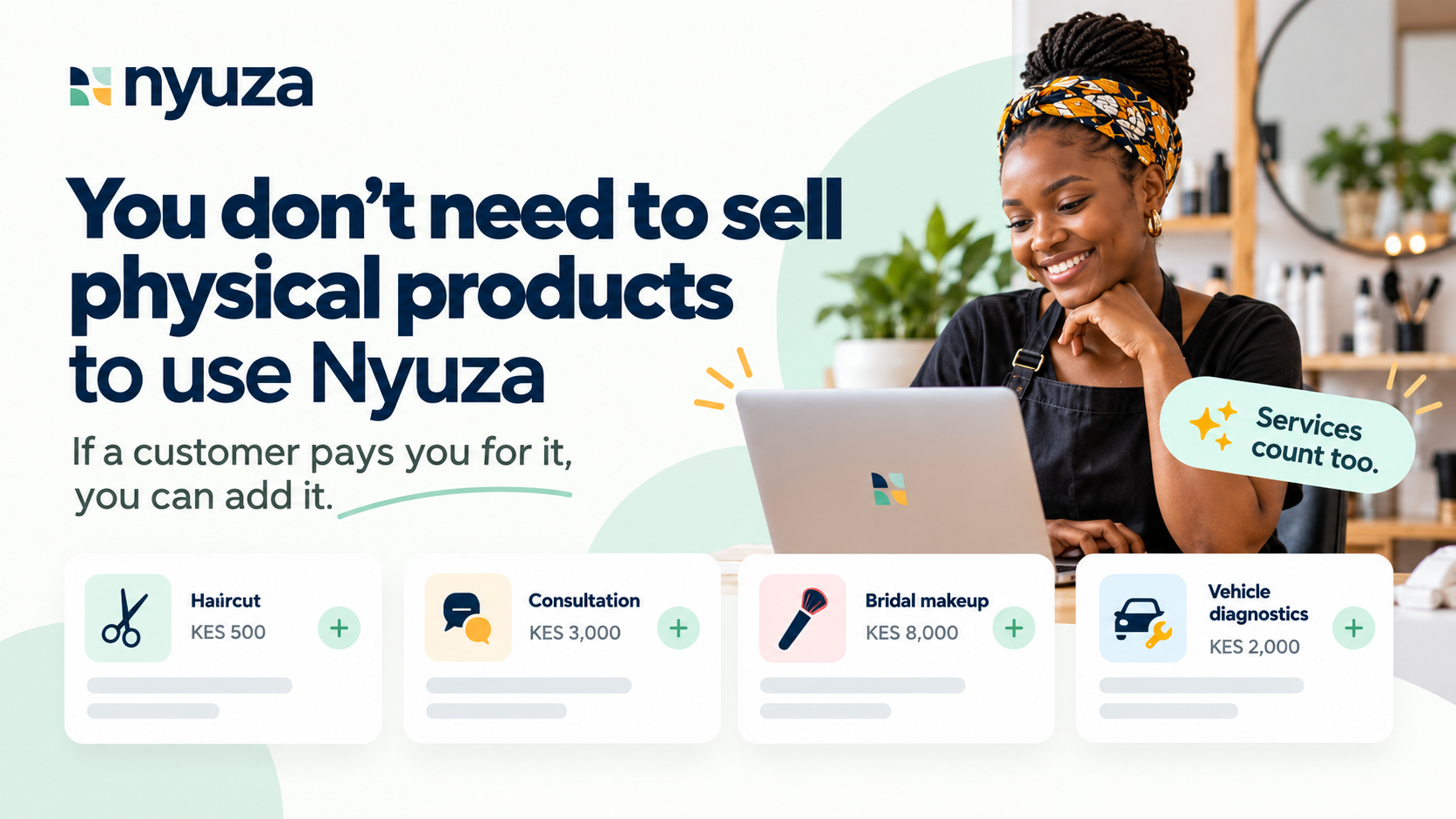
When we say product, it’s easy to think of something you can hold.
A shoe, cake, bottle of perfume, phone cover etc.
But plenty of Kenyan businesses don’t sell physical items at all. They sell a service.
A haircut. A consultation. A photoshoot. A repair. A delivery. A class. A makeup session. A car wash.
And Nyuza can work for those businesses too.
A service can still be your product
A simple way to think about it is this:
If a customer pays you for it, you can add it to Nyuza.
So if you run a salon, you might add a service like:
Braiding — KES 2,500
Haircut — KES 500
Manicure — KES 1,000
If you’re a consultant:
Consultation — KES 3,000
1-hour advisory session — KES 5,000
If you’re a photographer:
Birthday shoot — KES 15,000
Corporate headshots — KES 8,000
If you’re a mechanic:
Vehicle diagnostics — KES 2,000
You get the idea.
The question is not really:
“Do I sell products?”
It is:
“What does my customer pay me for?”
That is what you add.
Start with the service you do most often
Don’t overthink it.
You don’t need to create a long catalogue on day one.
Start with the thing customers ask you for most.
If you run a kinyozi, maybe it’s:
Haircut — KES 500
If you do home baking:
1kg birthday cake — KES 3,500
If you’re a physio:
Assessment session — KES 2,500
If you do makeup:
Bridal makeup — KES 8,000
One service is enough to start understanding how Nyuza fits into your business.
“But my prices are not always the same”
That’s also normal.
A lot of Kenyan businesses price depending on the job.
A fundi may charge differently depending on the repair.
A photographer may price depending on the event.
A caterer may price depending on the number of people.
A designer may price depending on the scope.
That should not stop you from starting.
You can still add the service in a simple way.
For example:
Site visit
Vehicle diagnostics
Logo design
Event photography
Then handle the exact customer details when creating the order.
Your catalogue does not need to capture every possible situation before you begin.
This is useful beyond just listing services
The bigger value is what happens after the service is added.
Instead of everything sitting in WhatsApp chats, notebooks or your head, you can start creating a clearer record of what each customer requested.
For example:
Wanjiku — Bridal makeup — KES 8,000
or
Otieno — Vehicle diagnostics — KES 2,000
or
Moraa — Birthday shoot — KES 15,000
Now the customer, the service and the amount all sit together.
That makes it easier to follow what is happening in the business.
And yes, deposits count too
A lot of service businesses don’t get paid once.
You might ask for a booking fee first.
Then a deposit.
Then the balance later.
For example:
Wedding photography — KES 60,000
Customer pays:
KES 20,000 deposit
Then later:
KES 40,000 balance
That is still one customer buying one service from your business.
So if your customers usually say:
“Nitatuma deposit leo, balance nikimaliza.”
That is not unusual.
That is exactly the kind of business flow Nyuza should help you keep track of.
Try this now
Think about the last customer you served.
What did they actually pay you for?
Add that.
Just:
The service name.
The price.
That’s enough to begin.
You can build the rest as you go.
Ready?
Add your first product or service →
Still figuring things out?
If you’re wondering where to start, read:
Start selling on Nyuza with just one product →
If you first want to understand how Nyuza fits into your normal day-to-day business, read:
Your first 10 minutes with Nyuza →